
B.S. Data Science and AI (DSAI) Curriculum
The Data Science & AI major is geared towards students who want to build competency in modern technologies. Students delve into fields such as generative AI, machine learning and programming while building fundamental skills in analytical thinking, mathematics and data processing. Courses in the Data Science and AI module are structured into six concentration modules:
- Digital Technology and Business
- Data Analytics
- Computer Science
- Programming and AI
- AI Engineering
- AI Application
Below is the curriculum structure and course list for the Data Science & AI major.
Course Structure
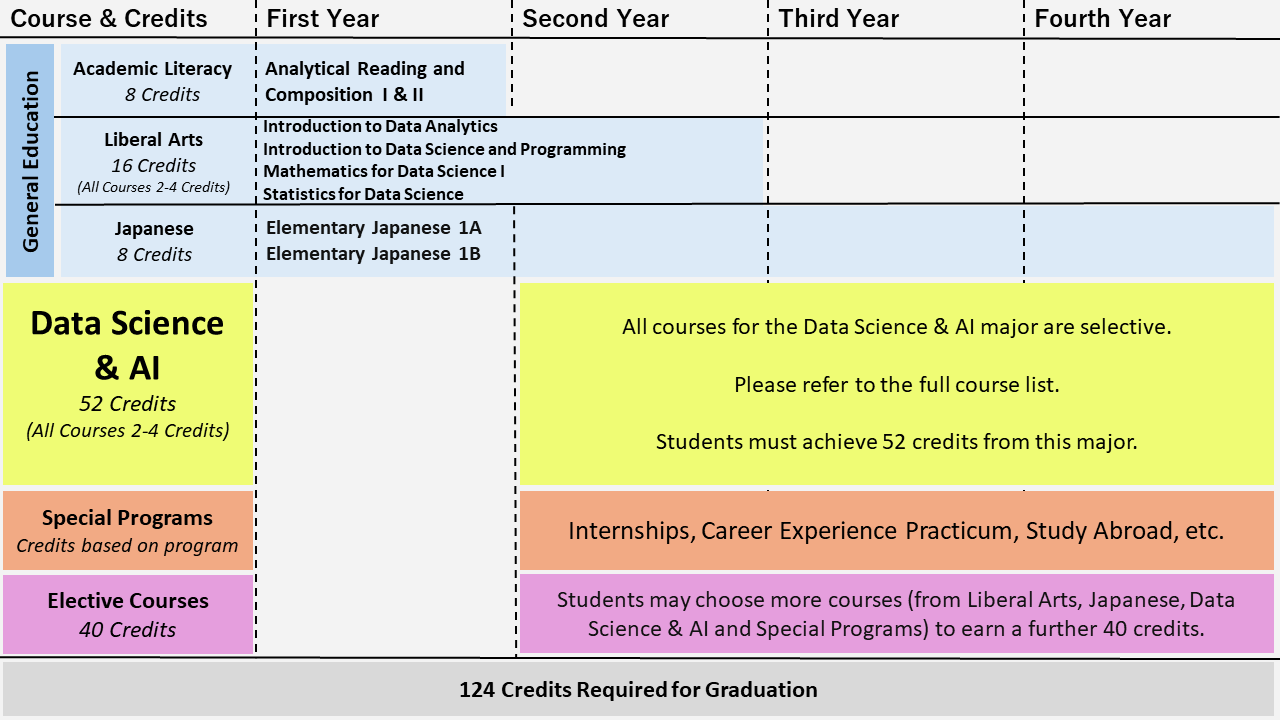
All Data Science & AI students will be required to take the following courses:
- Analytical Reading and Composition I
- Analytical Reading and Composition II
- Introduction to Data Analytics
- Introduction to Data Science and Programming
- Mathematics for Data Science I
- Statistics for Data Science
- Elementary Japanese 1A
- Elementary Japanese 1B
Further Japanese courses are optional.
Full Course List
Data Science & AI Courses
AI and Intelligent Product Development
This course explores how AI can be embedded into products across their entire lifecycle. Students learn to integrate AI with product design, intelligent agents, and platform-based development. This course examines AI opportunities across different industries and application domains, preparing students to design and architect intelligent, AI-enabled products.
Concentration Module: AI Application
AI Engineering
This course focuses on building, deploying, and managing AI-powered applications. Students learn to connect Large Language Models or Machine Learning Models to software via Application Programming Interfaces, and to turn various models into scalable and reliable products.
Concentration Module: AI Engineering
Big Data Management
This course examines database design and SQL programming, the foundations of database systems, and core concepts such as the relational algebra and data model, query optimization, query processing, and transactions. Students learn how to design and implement data strategies, on-premise and cloud systems, and centralized and distributed architectures. With this knowledge, students are empowered to make informed decisions about which technologies to use in certain situations for specific goals.
Concentration Module: Programming and AI
Computation Structures
This course introduces the architecture of digital systems, emphasizing structural principles common to a wide range of technologies. This course covers topics including multilevel implementation strategies, the definitions of new primitives and their mechanization using lower-level elements, and other topics, providing a deep understanding of how computation works beneath the surface.
Concentration Module: Computer Science
Computer System Design
This course covers topics on the engineering of computer software and hardware systems. Topics include techniques for controlling complexity, modularity using client-server design, operating systems, networks, security and privacy.
Concentration Module: Computer Science
Cybersecurity and Applications
This course introduces key concepts in cybersecurity and their applications in digital environments. It explores basic approaches to protecting systems, data, and networks.
Concentration Module: AI Application
Data Science and AI Project I
This first capstone course allows students to apply their knowledge to a real-world data science or AI project. Working in teams, students define a problem, acquire and preprocess data, and begin designing an AI solution. The course emphasizes project planning, collaboration, and iterative development. It lays the foundation for a complete end-to-end AI system.
Concentration Module: AI Application
Data Science and AI Project II
Building on Project I, this course focuses on refining and completing the capstone project. Students improve models, strengthen system design, and conduct rigorous evaluation. The course emphasizes professional documentation and presentation of results. Students complete the course with a polished project suitable for portfolios and industry use.
Concentration Module: AI Application
Discrete Optimization
This is an intermediate algorithms course that examines the design and analysis of efficient algorithms, with an emphasis on methods of application. Topics include divide-and-conquer, randomization, dynamic programming, greedy algorithms, incremental improvement, complexity, and cryptography.
Concentration Module: Computer Science
Generative AI
This course introduces the core concepts and practical applications of Generative AI and large language models. Students learn prompt engineering, output evaluation, and application design using existing AI tools and platforms. The course emphasizes responsible use, addressing ethical, social, bias, and reliability concerns. It prepares students to apply generative AI effectively in digital and business contexts.
Concentration Module: AI Engineering
Introduction to Data Analytics
This course introduces statistical thinking for analyzing and interpreting data in real-world contexts. Students learn core concepts such as exploratory data analysis, probability, hypothesis testing, and regression. Using the R programming language, the course emphasizes hands-on analysis of data science problems. It builds a strong foundation for evidence-based decision-making using data.
Concentration Module: Data Analytics
Mathematics for Data Science I
This course teaches essential calculus concepts for data science, as well as their mathematical notation, physical meaning, and geometric interpretation. Students will gain insight into real-world applications of these mathematical concepts, as well as an understanding of the differentiation and integration of single variable and coordinated systems, to develop fundamental computation skills for problem solving.
Concentration Module: Data Analytics
Mathematics for Data Science II
This course expands mathematical foundations with vectors and matrices, partial derivatives, double and triple integrals, vector calculus, and discrete mathematics. Fundamental concepts are also taught, including definitions, proofs, sets, functions, graphs and networks. Students will be able to explain and apply discrete methods in subsequent courses in the design and analysis of algorithms, software engineering, and computer systems.
Concentration Module: Data Analytics
Practical Programming in C
This course introduces the C programming language, a foundation of modern operating systems and embedded systems. Students learn core syntax and practical programming techniques, progressing to advanced topics such as memory management, concurrency, and synchronization. The course prepares students for careers in systems and embedded software development.
Concentration Module: Programming and AI
Principles of Algorithms
This course provides an introduction to mathematical modeling of computational problems. It covers the common algorithms, algorithmic paradigms, and data structures used to solve these problems. The course emphasizes the relationship between algorithms and programming, and introduces basic performance measures and analysis techniques for these problems.
Concentration Module: Computer Science
Principles of Deep Learning
This course explores neural networks and modern deep learning architectures inspired by the human brain. Students learn models such as Convolutional and Recurrent Neural Networks used in computer vision and speech recognition. The course emphasizes practical problem-solving with deep learning techniques. Students gain insight into how deep learning enables powerful AI systems.
Concentration Area: Programming and AI
Principles of Machine Learning
This course introduces principles, algorithms, and applications of machine learning from the point of view of modeling and prediction. It includes the formulation of learning problems and concepts of representation, over-fitting, and generalization. These concepts are exercised in supervised learning and reinforcement learning, with a variety of practical applications.
Concentration Module: Programming and AI
Python for Data Science
This course examines techniques for using Python in data science as well as the different frameworks in Python for solving real-world problems. Students learn to use standard Python tools to write code for data collection, preprocessing, analysis and visualization. This course also discusses using AI-assisted coding tools responsibly while maintaining correctness and reproducibility.
Concentration Module: Programming and AI
Quantum Information and Computation
This advanced, intensive course examines quantum computation and emerging quantum technologies. Students study foundational theory alongside hands-on Python implementation using scientific computing libraries such as NumPy and SciPy. This course includes designing and running quantum algorithms on IBM's real quantum hardware. It prepares motivated students for advanced research and future work in quantum computing.
Concentration Module: AI Application
Software Construction
This course examines fundamental principles and techniques of software development. Students learn techniques on writing software that is safe, adaptable and easy to understand. Topics covered in this course include specifications and invariants, testing, abstract data types, design patterns for object-oriented programming, concurrent programming and concurrency, and functional programming.
Concentration Module: Computer Science
Statistical Analysis
This course explores the theoretical foundations of statistical inference and modeling. Students study topics including sufficiency and completeness, point estimation via maximum likelihood and Bayes, estimator optimality via UMVUE, hypothesis testing and confidence regions, and Markov chain Monte Carlo for Bayesian inference. Emphasis is placed on rigorous reasoning and research-level analysis. Extensive use of R prepares students for advanced data science research and applications.
Concentration Module: Data Analytics
Statistics for Data Science
This course introduces probabilistic reasoning and statistical models used in data science. Topics include conditional probability, distribution of random variables and order statistics, sampling and sampling distributions, law of large numbers, and central limit theorem. Students also learn statistical models including linear, binary, and multinomial logistic regression models, using the R computing language as applicable.
Concentration Module: Data Analytics
Digital Business & Innovation (DBI) Shared Courses
Students enrolled on the DSAI major may participate in the following Digital Business & Innovation (DBI) courses. All of the following courses fall under the Digital Technology and Business concentration module.
Blockchain and Business Apps
In this course, students will examine the foundations and applications of blockchain technology in digital business and innovation. The course explores the technological, legal, political, and social dimensions of blockchain systems, including consensus protocols, anonymity, security challenges, and emerging developments. Students will also analyze real-world blockchain applications and contemporary issues related to the future of blockchain technology.
Business Analytics and AI Project
In this course, students will examine the role of business analytics and artificial intelligence in contemporary organizational strategy and decision-making. The course explores business analytics processes, project lifecycles, model development, and data-driven problem-solving from a practical perspective. Through project-based learning and applied analysis, students will develop and evaluate business analytics projects while considering performance measurement, cost-effectiveness, and model explainability.
Corporate Finance
In this upper-level undergraduate course, students will examine the fundamental principles of corporate finance and major financial issues faced by corporate decision-makers. Topics include financial statement analysis, time value of money, valuation, and capital budgeting decisions. Students will also explore capital markets, risk and return analysis, capital structure theories, and dividend policy.
Digital Banking and Fintech
In this course, students will examine key concepts in digital banking and financial technology (fintech). The course covers e-banking, financial systems, and the role of digital technologies in modern finance. Students will explore the impact of big data and artificial intelligence on financial services and the emerging digital economy. The course also introduces foundational topics such as data mining, cloud computing, and blockchain technologies.
Digital Marketing
In this course, students will examine advanced concepts in digital marketing with an emphasis on artificial intelligence and automation. The course explores AI-powered marketing workflows, customer segmentation, and the use of data-driven tools in marketing decision-making. Students will also study search advertising and campaign optimization, including keyword strategy, budgeting, and performance evaluation. Through applied projects and simulations, students will develop practical skills in designing and evaluating AI-enabled digital marketing systems.
Digital Marketing and E-Commerce
In this course, students will examine advanced concepts in digital marketing with an emphasis on artificial intelligence and automation. The course explores AI-powered marketing workflows, customer segmentation, and the use of data-driven tools in marketing decision-making. Students will also study search advertising and campaign optimization, including keyword strategy, budgeting, and performance evaluation. Through applied projects and simulations, students will develop practical skills in designing and evaluating AI-enabled digital marketing systems.
Econometrics for Business Analytics
In this course, students will develop fundamental econometric tools and analytical skills for analyzing economic relationships using real-world data. The course covers statistical foundations, regression analysis, model diagnostics, and basic causal inference. Students will also explore key econometric techniques such as OLS estimation and instrumental variables. Through applied exercises and data-based examples, students will learn how to interpret and analyze empirical economic evidence.
Financial Accounting
This course explores the basic principles of financial accounting. It introduces key ideas related to financial reporting and business records.
Innovation and Value Creation for Entrepeneurs
In this course, students will examine how entrepreneurs create value through innovation. The course explores key ideas related to opportunity recognition, problem solving, and business development. Students will also consider how innovative thinking can be applied to entrepreneurial contexts.
Investments
This course explores the basic concepts of investment and financial markets. It introduces key ideas related to asset management and financial decision-making.
IT Project Management
This course explores how information technology projects are planned and managed. It introduces key ideas related to project organization and execution.
Microeconomics
In this course, students will examine the basic principles of microeconomic theory and their applications to economic and policy issues. The course covers key topics such as supply and demand, consumer behavior, the theory of the firm, market structures, and welfare analysis. Students will also explore strategic behavior, information economics, general equilibrium, and market failures. The course emphasizes the application of microeconomic models to real-world problems.
Neuro Marketing
In this course, students will examine the foundational concepts and tools of neuromarketing. The course introduces key ideas in understanding consumer behavior through neuroscience-based approaches. Students will develop critical thinking regarding the ethical and practical applications of neuromarketing. The course also focuses on basic skills for analyzing and evaluating consumer behavior using neuromarketing techniques.
Neuro Marketing Project
This course explores practical applications of neuromarketing. It introduces key ideas related to consumer behavior and marketing research projects.
Principles of Marketing
In this course, students will examine the basic principles of marketing. The course covers key concepts such as segmentation, targeting, positioning, and the marketing mix. Students will learn how these elements work together to create effective market offerings. Case studies from international and Japanese contexts will be used to support discussion and analysis.
Start-up Funding and VC Strategies
In this course, students will examine the fundamentals of start-up financing from early-stage funding to venture capital investment. The course explores key aspects of fundraising, including assessing capital needs, pitching to investors, and understanding deal structures. Students will also study valuation approaches, funding stages, and investor expectations through applied examples. The course bridges theory and practice to support understanding of how start-ups raise capital and how investment decisions are made.
Strategic Brand Management
This course explores how brands are developed and managed. It introduces key ideas related to branding and marketing strategy.
Text Mining and Deep Learning
This course explores techniques for analyzing text data using machine learning. It introduces key ideas related to deep learning and language data.
Liberal Arts Courses
Introduction to Cultural Anthropology
In this course, students will examine the field of cultural anthropology and its study of human societies and ways of life. The course explores how people in different environments create, organize, and are shaped by cultural systems. Students will also learn basic concepts, theories, and methods used in anthropological research. The course includes comparative perspectives on cultures from different regions, including examples from Japan.
Introduction to Data Analytics
This course introduces the basic concepts and methods of data analytics. It explores how data is used to identify patterns and support decision-making.
Introduction to Data Science and Programming
This course introduces the basic concepts of data science and programming. It explores how programming is used to analyze and work with data.
Introduction to Diplomacy and Foreign Policy
In this course, students will examine international relations through the practice of diplomacy. The course explores how diplomats and state actors shape and implement foreign policy in global politics. Students will study the institutions, actors, and processes of diplomacy and how they have evolved over time. The course also includes applied writing and analysis of real-world foreign policy issues.
Introduction to Law
This course introduces the basic concepts and structure of law. It explores how legal systems are organized and how laws function in society.
Introduction to Social Psychology
This course offers an introduction to the basic theories, and the empirical studies upon which the theories are based, of social psychology from a sociological perspective. At the core of social psychology is an effort to understand how social structures and psychic structures interact to produce social behavior. We will consider how social structures affect individuals, how individuals affect other individuals, and how individuals affect groups, or larger social structures.
Introduction to Sociology
This course introduces the basic concepts and approaches of sociology. It explores how societies are structured and how social life is organized and understood.
Introduction to the Islamic World
A brief introduction to Islam through introducing information about emergence of Islam. We shall start with an introduction about the history of Muhammad, since he was born until his death. Then we shall proceed to the philosophy and conception of human being in Islam. Then, there will be an introduction to what we can call “Islamic pillars”, such as pilgrimage, charity and fasting.
Introduction to International Relations
In this course, students will examine the major theoretical approaches in International Relations, including Realism, Liberalism, and Constructivism. The course also introduces selected non-Western perspectives to broaden understanding of global politics. Students will apply these theories to key issues in international relations and contemporary world affairs. The course connects theoretical concepts with real-world cases to support understanding of international politics.
Mathematics for Data Science I
This course introduces fundamental mathematical concepts used in data science. It explores basic tools for modeling and quantitative analysis.
Mathematics for Data Science II
This course builds on foundational mathematical concepts for data science. It explores additional tools used for more advanced quantitative analysis.
Principles of Economics
This course introduces the basic concepts of economics. It explores how individuals, firms, and markets make decisions.
Principles of Management
This course introduces the basic concepts of management. It explores how organizations are planned, organized, and operated.
Principles of Political Science
In this course, students will examine how politics both solves and creates societal problems. The course explores key questions in political science, including governance, inequality, development, conflict, and social change. Students will also be introduced to major themes, concepts, and methods used in political science. The course aims to develop a deeper understanding of how political systems function and how political outcomes can be analyzed.
Python for Data Science
This course introduces the Python programming language for data science applications. It explores how Python is used to process and analyze data.
Statistics for Data Science
This course introduces basic statistical concepts used in data science. It explores how data is summarized, analyzed, and interpreted.
Sustainable Society
This course introduces key ideas related to sustainability in society. It explores how social, economic, and environmental systems interact in the context of sustainable development.
World Economy
In this course, students will examine the historical evolution and dynamics of global capitalism from the 1400s to the present. The course explores competing perspectives on the rise and fall of nations and global economic development. Students will also study trade, financial flows, and patterns of globalization across different regions. The course includes discussion of major global challenges such as development, inequality, and governance.
Japanese Courses
Elementary Japanese 1A
This course explores the very basics of Japanese, covering hiragana and katakana and equipping students with some basic grammatical knowledge.
This course is mandatory for students without prior Japanese ability.
Elementary Japanese 1B
A continuation of the previous course, equipping students with basic grammatical and linguistical knowledge of the Japanese language. This course aims to reach the JLPT N5 level.
This course is mandatory for students without prior Japanese ability.
Elementary Japanese 2A
This course aims to build upon the basic foundations of Japanese that students have gained, introducing new forms and structures.
Elementary Japanese 2B
Similar to the the 2A course, this course aims to build upon the basic foundations of Japanese that students have gained, introducing new forms and structures. Students will reach the JLPT N4 level by the end of this course.
Intermediate Japanese 1
This course instils students with the Japanese they need to complete daily interactions. Students will be able to have basic conversations and express their circumstances and feelings in Japanese. Students will also build upon their knowledge of grammar, vocabulary and kanji.
Intermediate Japanese 2
Similar to the previous course, this course pushes students farther with the Japanese they need to complete daily interactions. Students will be able to have basic conversations and express their circumstances and feelings in Japanese. Students will also build upon their knowledge of grammar, vocabulary and kanji. By the end of this course, students will be prepared to take the JLPT N3 examination.
Advanced Japanese 1
This course will begin to develop students into fluent, confident users of Japanese. Building upon reading, writing, listening and speaking skills, students will gain the knowledge necessary to thrive in the Japanese workplace.
Advanced Japanese 2
Similar to the previous course, this course aims to fine-tune the Japanese ability of the student for use in a range of situations, including the workplace. This course will prepare students for the JLPT N2 examination, which is considered a strong standard when applying for Japanese companies.
Upper-Advanced Japanese
This course will usher students towards comprehensive fluency in the Japanese language. Students completing this course will be able to thrive in a range of fields: academia, the workplace, and wider Japanese society.
Business Japanese
In the final course of the TIU Japanese program, students will perfect their ability to use culturally appropriate forms in the world of Japanese business. This course will prepare students to sit the most challenging Japanese language examination: the JLPT N1.
Academic Literacy Courses
Analytical Reading and Composition I
In this course, students develop and practice skills in critical thinking, finding and evaluating sources, summarizing texts, and leading discussions before learning the process of writing an academic essay.
Analytical Reading and Composition II
In this course, following on from the first course, students continue develop and practice skills in critical thinking, finding and evaluating sources, summarizing texts, and leading discussions before refining their ability of academic writing.
Course lists and availability are subject to change without prior notice.