
B.A. International Relations (IR) Curriculum
The International Relations major equips students with the knowledge, communication skills, and global perspective needed to understand today’s interconnected world. Students explore international issues, diverse cultures, and global systems while developing the ability to think critically, analyze information, and solve problems independently and collaboratively. Graduates are prepared to contribute to society as responsible global citizens with a strong sense of ethics and humanity. Courses in the International Relations major fit into four concentration areas:
- Global Governance
- International Security
- International Political Economy
- Culture and Society
Below is the curriculum structure and course list for the International Relations major.
Course Structure
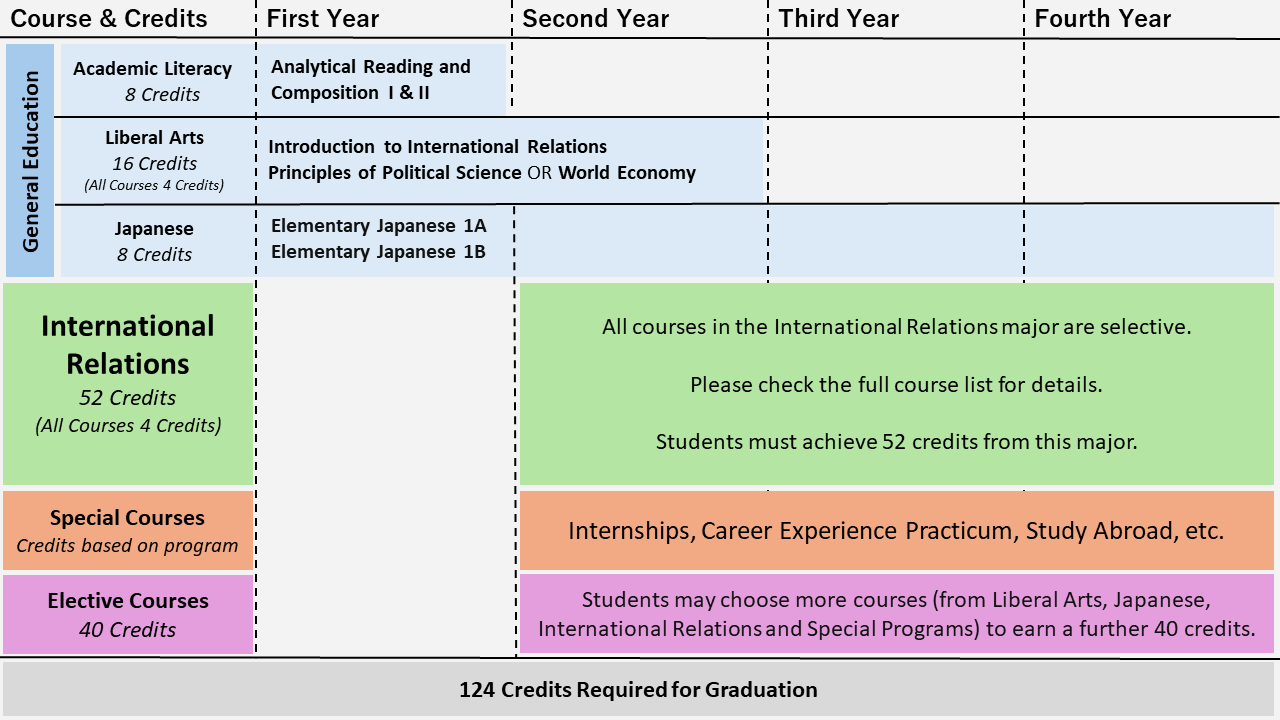
All International Relations students will be required to take the following courses:
- Analytical Reading and Composition I
- Analytical Reading and Composition II
- Introduction to International Relations
- Principles of Political Science OR World Economy
- Elementary Japanese 1A
- Elementary Japanese 1B
Further courses are selected based on the preferences and interests of the student. In addition, further Japanese courses are optional.
International Relations Courses
Chinese Politics in Comparative Perspective
In this course, students will examine key concepts and developments in Chinese politics. The first part of the course focuses on domestic political transitions, including Mao Zedong’s socialist program, Deng Xiaoping’s reforms, and China’s rapid rise in the post-Deng era. The second part explores China’s political system, including its ideologies, party-state structure, state-society relations, military, judiciary, political elites, culture, participation, and social and economic policy. The final part addresses China’s peripheries, with particular attention to Taiwan, Hong Kong, Tibet, and Xinjiang.
Concentration Areas: International Security, International Political Economy
Comparative Culture
In this course, students will examine the history and development of Japanese film from a comparative cultural perspective. Students will critically analyze conventional images of Japan represented in the works of directors such as Ozu Yasujirō, Kurosawa Akira, and Miyazaki Hayao, while exploring the influence of Western cinema, literature, and modern democratic thought on Japanese film culture. Through the study of film, students will develop a deeper understanding of how cultural values shape social behavior and intercultural interaction.
Concentration Areas: International Political Economy, Culture and Society
Comparative Political Institutions
In this introductory course, students will examine the key theories and debates in the field of comparative politics. Students will also explore the political, economic, and cultural development of diverse world regions. Through the comparative study of political systems across different countries, students will analyze the historical evolution and future trajectories of domestic politics in global contexts.
Concentration Areas: Global Governance, Culture and Society
Comparative Politics
In this course, students will examine the major theories and debates in the field of comparative politics. Students will also explore the political, economic, and cultural development of various world regions. Through the comparative study of political systems across different countries, students will analyze the historical evolution and future trajectories of domestic politics in diverse global contexts.
Concentration Areas: International Security, International Political Economy
Contemporary Japanese Literature
In this course, students will examine the major transformations in Japanese literature from the Tokugawa period to the present day. Students will explore how political and social change, including the arrival of Commodore Perry and the collapse of the Tokugawa Shogunate, influenced literary style, form, and content. Through the study of significant authors and works from the past century, students will analyze the historical and social contexts in which these texts were produced. Students will also participate in class discussions and complete written assessments, including a final paper on an author or text of their choice.
Concentration Areas: Culture and Society
Critical Approaches to Development Politics
This course explores critical approaches to development politics. It introduces key ideas related to development, governance, and political change. Students examine how different perspectives shape understandings of development processes and outcomes.
Concentration Areas: Global Governance, International Political Economy
Defense Strategy and Planning
This course explores the fundamentals of defense strategy and planning. It introduces key ideas related to security policy, strategic thinking, and planning processes. Students examine how defense strategies are developed and implemented in different contexts.
Concentration Areas: Global Governance, International Security
Gender in International Relations
In this course, students will examine the critical feminist approach to international relations and compare it with the two major traditions of realism and liberalism. Students will analyze how these perspectives understand the state and citizenship, conflict, peace and security, gender, sexuality and human rights, the global political economy, and development. Through comparative study, students will develop a deeper understanding of how theoretical approaches shape interpretations of global politics.
Concentration Areas: Culture and Society
Global Sociology
In this course, students will examine social institutions as key structures of society from a comparative global perspective. Topics include the family, education, work, healthcare, political and economic systems, religion, crime and punishment, and the nation-state. Students will develop an understanding of how these institutions function across different societies and cultural contexts.
Concentration Areas: Global Governance, International Political Economy, Culture and Society
Human Rights
In this course, students will examine the emergence of global human rights and humanitarian practice within the context of international relations. Students will explore the development of human rights systems at the global, regional, and local levels, with particular attention to the growth of the international human rights movement and its significance in world politics. The course will familiarize students with major international and regional human rights institutions, including those of the United Nations, the Council of Europe, the Organization of American States, and ASEAN, while also addressing key debates and critiques surrounding human rights.
Concentration Areas: Global Governance, Culture and Society
International Development
In this course, students will examine how national development begins and the economic, political, and social structures necessary to promote sustainable growth. Students will explore the relationship between income growth and broader development, with particular attention to the importance of effective political institutions and civil society. The course will also address key issues such as income disparity and poverty through comparative analysis of countries at different stages of development.
Concentration Areas: Global Governance, Culture and Society
International Environmental Policy
In this course, students will examine major issues in global environmental politics and governance. The course explores topics such as climate change, deforestation, biodiversity loss, and resource-related challenges from international and political perspectives. Students will also analyze the role of global environmental governance and the challenges involved in international cooperation and policy implementation.
Concentration Areas: Global Governance, International Political Economy
International Integration
In this course, students will examine regional integration as an approach to promoting peace, stability, and shared economic development. Through comparative analysis, students will explore integration processes in regions including Europe, Asia, the Americas, and, where relevant, Africa, the Pacific, and the Middle East and North Africa. Particular emphasis is placed on the European Union as a significant case of regional integration. Using newspapers and academic literature, students will analyze contemporary trends and debates surrounding regionalism worldwide.
Concentration Areas: Global Governance, International Political Economy
International Law
This course aims to present a panorama of public international law, which covers rules that govern the relations basically between states. The course will start with an introduction to the international legal order as compared to domestic law and society. It will then focus on core areas of public international law which involve the following: subjects and sources of international law, jurisdiction, diplomatic relations, the law of the sea, settlement of international disputes, and prohibition of the use of force.
Concentration Areas: Global Governance, International Political Economy
International Organization
In this course, students will examine the possibilities and limitations of cooperation among sovereign states within the international system. Students will explore the historical development, functions, and operations of international organizations such as the League of Nations and the United Nations. The course will also address contemporary global issues, including collective security under the United Nations, international criminal justice, and climate change.
Concentration Areas: Global Governance
International Political Economy
In this course, students will develop an understanding of the field of international political economy through the study of its major theories and concepts. Topics include international economic institutions, globalization, economic inequality, environmental policy, and the resource curse. Students will apply this knowledge in the development of an independent research paper.
Concentration Areas: International Security, International Political Economy
International Politics
In this course, students will survey the field of international politics through the study of war and peace from theoretical and historical perspectives. Students will examine key questions such as the causes of violence in human and interstate conflict, the relationship between state behavior and human behavior, and the conditions under which nations are more likely to cooperate.
Concentration Areas: Global Governance, International Political Economy
International Relations of Asia-Pacific
In this course, students will examine the major relations and issues shaping the Asia-Pacific region. Students will analyze the national interests, motivations, and policies of key actors, including China, the United States, Japan, India, Russia, Australia, South Korea, Hong Kong, and Singapore. The course also considers the perspectives of peripheral states and regional organizations such as ASEAN, APEC, and Latin American partners. Economic frameworks including NAFTA, CPTPP, RCEP, the Belt and Road Initiative, and the Free and Open Indo-Pacific strategy will be explored alongside political issues such as maritime security, hedging strategies, and non-traditional security challenges. Interactive activities such as Model APEC will support students’ understanding of regional order formation.
Concentration Areas: International Political Economy, Culture and Society
International Relations of Central Asia
This course explores the international relations of Central Asia. It introduces key ideas related to regional politics, external influences, and cooperation. Students analyze the region’s role within broader international systems.
Concentration Areas: International Security, Culture and Society
International Relations of China
In this course, students will examine the historical context of China’s rise and evaluate international relations theories concerning whether China should be understood as a status quo or revisionist power. Students will analyze the principles and development of Chinese foreign policy, with particular attention to the policy of non-intervention. The course also explores issues of major significance for world order, including China’s economic and military capabilities, as well as its expanding soft power and public diplomacy efforts.
Concentration Areas: Global Governance, International Security, International Political Economy
International Relations of Europe
In this course, students will examine the international relations of Europe since 1945, with particular emphasis on the external relations of the European Union and its member states. Students will explore the European Union’s external policy-making processes through the study of key institutions, including the Council of Ministers, the European Parliament, the European Commission, and the European Court of Justice. The course also surveys EU policies toward major strategic partners and concludes with an analysis of contemporary challenges facing the EU and the foreign policies of its member states. Practical case studies in confidence-building and conflict resolution, including Moldova, may also be incorporated.
Concentration Areas: Global Governance, International Security
International Relations of Japan
In this course, students will examine Japan’s international relations from historical and theoretical perspectives. Students will explore how domestic and international factors have constrained and shaped Japanese foreign policy over the past 150 years. The course first reviews major developments since the Meiji Restoration, then analyzes key contemporary issues in Japan’s international relations, and concludes with discussion of selected topics from the lectures.
Concentration Areas: Culture and Society
International Relations of South Asia
In this course, students will examine the domestic and external determinants of foreign policy in the states of South Asia. The course explores how foreign policy has been structured and implemented in areas such as security, defense cooperation, conflict and competition, trade and investment, and regional economic cooperation. Through theoretical analysis and selected case studies, students will engage critically with key debates in contemporary international relations in South Asia.
Concentration Areas: International Security, International Political Economy
International Relations of Southeast Asia
This course explores the international relations of Southeast Asia. It introduces key ideas related to regional dynamics, cooperation, and external relations. Students examine how states interact within regional and global contexts.
Concentration Areas: International Security
International Relations of the Middle East
In this course, students will examine the international relations of the Middle East from both historical and theoretical perspectives. Students will develop the ability to analyze the complex history of the Middle East while critically evaluating existing theories of international relations and comparative politics. The course also considers how theories developed primarily from Western experiences may be challenged, refined, or expanded through the study of regional actors and political processes in the Middle East.
Concentration Areas: International Security, Culture and Society
International Security
In this course, students will examine the development of international relations and security studies in the post-Cold War era, with attention to the expansion of new subfields and changing scholarly priorities. Students will study major theories concerning the causes of war and analyze how these theories relate to broader approaches in international relations. The course will also address contemporary security challenges and policy issues of significance in today’s global environment.
Concentration Areas: Global Governance, International Security
Issues in Popular Culture
In this undergraduate course, students will examine major concepts and theories concerning the nature of popular media and culture. Topics include the shaping of public opinion, the heroic myth cycle, and other key themes in media and cultural studies. Students will engage with theorists such as Bernays, Adorno, Debord, Halbwachs, and Bakhtin, applying their ideas to contemporary examples and evaluating their relevance. Active participation is expected through class and online discussions, and students will complete written assessments including midterm and final essay examinations.
Concentration Areas: Culture and Society
Japan and the Islamic World
A brief introduction to Islam through introducing information about emergence of Islam. We shall start with an introduction about the history of Muhammad, since he was born until his death. Then we shall proceed to the philosophy and conception of human being in Islam. Then, there will be an introduction to what we can call “Islamic pillars”, such as pilgrimage, charity and fasting. After this introduction to Islam we shall proceed to a brief introduction to Shinto.
Concentration Areas: Global Governance, Culture and Society
Japanese Politics in Comparative Pespective
In this course, students will examine the distinctive features of Japan’s political and economic systems in comparative perspective, with attention to their successes, limitations, and broader significance. The first part of the course focuses on the emergence and consolidation of Japan’s “1955 System.” The second part explores the period of transition after 1993, analyzing how economic, social, and political change disrupted the previous order and contributed to the development of a new political and economic framework.
Concentration Areas: International Security
Japanese Popular Culture
In this course, students will examine the history of manga, anime, and filmmaking in Japan. Students will explore major works, creators, and genres, while also studying other forms of popular culture such as video games and music. The course further considers how concepts including nationalism, collective memory, trauma, and politics influence the development and reception of popular culture.
Concentration Areas: Culture and Society
Japanese Society
In this course, students will examine key social institutions in contemporary Japan, including families, schools, and workplaces, in the context of recent demographic and structural changes in Japanese society and political economy. Students will also critically analyze mass media reports alongside academic scholarship in order to assess how empirical realities may be interpreted, framed, or distorted to support particular arguments and social discourses.
Concentration Areas: Culture and Society
Maritime Security and Ocean Governance
In this course, students will examine the international rules and norms that govern the world’s oceans and seas, with particular emphasis on the United Nations Convention on the Law of the Sea (UNCLOS). Students will explore the historical development of maritime law, including the division between sovereign and non-sovereign maritime areas and the balance between coastal state authority and freedom of navigation. The course will also introduce UNCLOS provisions on maritime entitlements and address contemporary issues such as maritime disputes, transnational crime, and environmental protection, with attention to the interaction of international law, policy, and politics in global ocean governance.
Concentration Areas: Global Governance, International Security
Media and Society in Japan
In this course, students will examine media and society in Japan through the study of both media content and media systems. Students will analyze how media messages are shaped by producers and audiences, and how these messages influence social behavior, perception, and patterns of thought. By the end of the course, students will be able to critically evaluate public and commercial media in Japan and explain the social and psychological impact of media communication.
Concentration Areas: Culture and Society
Military Alliances and Security Cooperation
In this course, students will examine military alliances and security cooperation in international politics, with particular attention to United States foreign policy. The course first introduces the concept of alliances, then surveys alliance life cycles, including their formation, management, and dissolution. Students will explore different alliance types and case studies such as NATO and U.S. alliances in East Asia, while also analyzing challenges including the security dilemma, credibility, cohesion, burden sharing, alliance expansion, and extended deterrence. The course concludes by considering alternatives to alliances, including wedge strategies, arms transfers, and collective security arrangements.
Concentration Areas: Global Governance, International Security
Nationalism and Memory Politics
This course explores nationalism and memory politics in global contexts. It introduces key ideas related to identity, historical narratives, and political memory. Students analyze how the past is used in contemporary political discourse.
Concentration Areas: International Security, Culture and Society
Political Development of Asia
In this course, students will examine the major theories and debates in the field of Asian politics while gaining an introduction to the political, economic, and cultural history of the region. The course surveys the long history of East Asia from its pre-colonial origins to the present, considering patterns of conflict and cooperation across time. Particular attention is given to Japan, China, Korea, and later Taiwan and North Korea, while also assessing the extent to which Eurocentric theories can explain regional developments.
Concentration Areas: International Security, International Political Economy
Political Economy of Development
In this course, students will examine the meaning of development and the strategies through which nations pursue socio-economic progress. Students will explore the differing levels of development achieved across countries, as well as the internal and external factors that contribute to these outcomes. Through the study of major theories in development studies and selected case studies from developing economies, students will analyze patterns of economic growth and social change through intensive reading and discussion.
Concentration Areas: International Political Economy, Culture and Society
Political Philosophy
This class will help students to better understand their role as citizens in a democratic society and to think critically about political issues. A major focus of this class will be to not only describe how the political world is but also how it should be. Topics will include: democracy, distributive justice, liberty and human nature. Furthermore, this course will help students to strengthen their reading and writing skills. Finally, students should be able to better understand the historical development of ideas, gain a better understanding of their own political views and acquire more tools with which to become involved in politics.
Concentration Areas: Global Governance, Culture and Society
Political Theory
In this course, students will examine their role as citizens in a democratic society and develop the ability to think critically about political issues. The course considers not only how political systems function, but also how they ought to be organized. Topics include democracy, distributive justice, liberty, and human nature. Students will also strengthen their reading and writing skills while gaining a deeper understanding of the historical development of political ideas, their own political perspectives, and the means of civic engagement.
Concentration Areas: International Political Economy, Culture and Society
Pre-modern Japanese Literature
In this course, students will examine the nearly 1,500-year pre-modern tradition of Japanese literature from the Asuka period to the late Tokugawa period. Students will explore a wide range of literary works and their historical and cultural contexts in order to develop a deeper understanding of Japanese literature, history, and society. Authors studied may include Murasaki Shikibu, Zeami, and Ueda Akinari. Students will also participate in class discussions and complete written assessments, including a midterm examination and final paper.
Concentration Areas: Culture and Society
Regional Governance in Asia
This course explores regional governance structures in Asia. It introduces key ideas related to institutions, cooperation, and regional order. Students examine how governance frameworks shape regional interaction.
Concentration Areas: Global Governance, Culture and Society
Resource Politics
In this course, students will examine major theories, ideas, and research in the field of resource politics. Students will survey a wide range of studies concerning the political and economic significance of natural resources. The course also explores the role resources have played in the development of specific states and compares different governance strategies that governments may pursue in the management of the resource sector.
Concentration Areas: Global Governance, International Political Economy
Russian Politics
This course explores the political system and dynamics of Russia. It introduces key ideas related to governance, institutions, and political development. Students analyze domestic and international dimensions of Russian politics.
Concentration Areas: International Security, Culture and Society
Security on the Korean Peninsula
This course explores security issues on the Korean Peninsula. It introduces key ideas related to conflict, diplomacy, and regional stability. Students examine historical and contemporary security challenges in the region.
Concentration Areas: Global Governance, International Security
Transitional Justice
This course explores transitional justice in post-conflict societies. It introduces key ideas related to accountability, reconciliation, and legal-political processes. Students examine how societies address past conflicts and human rights violations.
Concentration Areas: Global Governance
Transport Governance and Security
In this course, students will examine the governance and security of the transport sector within the Indo-Pacific region, an area vital to economic activity and social development. The first half of the course focuses on transport governance, including the frameworks and mechanisms used to regulate and manage transport systems. The second half explores security challenges affecting or arising from the transport sector in the Indo-Pacific, with attention to contemporary regional issues and interdependence among states.
Concentration Areas: Global Governance, International Security
U.S. Policy towards Asia
In this seminar course, students will examine the dynamic relationships between the United States and Indo-Pacific countries, multilateral institutions, and non-state actors across Northeast Asia, Southeast Asia, South Asia, and Australia. The course is structured in three parts. The first part focuses on U.S. foreign policy toward the Indo-Pacific, analyzing its origins and determinants. The second part explores the historical evolution of U.S. foreign policy in Asia, and the third examines contemporary policy issues in the region. As a seminar, the latter two sections are student-led, with the instructor facilitating discussion. Students are expected to integrate knowledge from other courses in their analytical work.
Concentration Areas: International Security, International Political Economy
U.S. Policy and Foreign Policy
This course explores U.S. foreign policy and global engagement. It introduces key ideas related to strategy, diplomacy, and international relations. Students analyze the role of the United States in global affairs.
Concentration Areas: International Security
Understanding Globalization
In this course, students will examine the major concepts, debates, and perspectives related to political, economic, and cultural globalization. The course also addresses transnational challenges associated with globalization, including human and drug trafficking, environmental degradation, poverty, health issues, terrorism, and the proliferation of weapons of mass destruction. Students will be encouraged to evaluate the impact of globalization on their own lives, communities, and home countries. Through class discussions and interactive learning activities, students will develop critical perspectives on contemporary global issues.
Concentration Areas: International Political Economy, Culture and Society
War and Peace in East Asia
This course explores war and peace in East Asia. It introduces key ideas related to conflict, cooperation, and regional security. Students analyze historical and contemporary dynamics shaping regional stability.
Concentration Areas: International Security
Liberal Arts Courses
Introduction to Diplomacy and Foreign Policy
In this course, students will examine international relations through the practice of diplomacy. The course explores how diplomats and state actors shape and implement foreign policy in global politics. Students will study the origins, roles, and evolving nature of diplomatic institutions and practices. Through discussions and written assignments, students will apply analytical skills to real-world foreign policy issues.
Concentration Areas: Global Governance, International Security
Introduction to Cultural Anthropology
In this course, students will examine the field of cultural anthropology and its study of human societies and ways of life. The course explores how people in different environments create, share, and are shaped by cultural systems. Students will also learn key concepts, theories, and methods used in anthropological research. Through comparative perspectives, the course considers cultural similarities and differences, including examples from Japan and other regions.
Concentration Areas: Culture and Society
Introduction to Law
This course introduces the basic concepts and structure of law. It explores how legal systems are organized and how laws are created and applied. Students examine the role of law in regulating society and social behavior.
Concentration Areas: Global Governance, Culture and Society
Introduction to Social Psychology
In this course, students will examine the basic theories and empirical foundations of social psychology from a sociological perspective. The course explores how social structures and individual psychological processes interact to shape human behavior. Students will also study how individuals influence one another, as well as how they are influenced by groups and broader social systems.
Concentration Areas: International Security, Culture and Society
Introduction to Sociology
This course introduces the basic concepts and approaches of sociology. It explores how societies are structured and how social relationships are formed and maintained. Students examine key themes in understanding social life and social organization.
Concentration Areas: Global Governance, Culture and Society
Introduction to the Islamic World
In this course, students will examine an introduction to Islam and its historical emergence. The course explores the life of Muhammad, from his early history through to his death, as well as key aspects of Islamic belief and practice. Students will also study foundational concepts such as the pillars of Islam, including pilgrimage, charity, and fasting.
Concentration Areas: Global Governance, Culture and Society
Introduction to International Relations
In this course, students will examine the major theoretical approaches in International Relations, including Realism, Liberalism, and Constructivism. The course also introduces selected non-Western perspectives to broaden understanding of global politics. Students will apply these frameworks to key issues in international relations and contemporary world affairs. The course connects theoretical concepts with real-world cases to support analytical understanding of international politics.
This course is mandatory for all International Relations students.
Principles of Political Science
In this course, students will examine how politics both addresses and creates societal problems. The course explores key questions in political life, including governance, democracy, inequality, development, conflict, and social change. Students will also be introduced to major themes, concepts, and methodological approaches in political science. Through this framework, the course develops understanding of how political systems function and how political outcomes can be analyzed.
This course (or, alternatively, World Economy) is mandatory for all International Relations students.
Sustainable Society
This course introduces key ideas related to sustainability in society. It explores how social, economic, and environmental systems interact in the context of sustainable development. Students examine challenges and approaches to building more sustainable societies.
Concentration Areas: International Political Economy, Culture and Society
World Economy
In this course, students will examine the historical evolution and dynamics of global capitalism from the 1400s to the present. The course explores major phases of globalization and competing perspectives on the rise and fall of nations. Students will also study international trade, financial flows, and patterns of global development and underdevelopment. The course includes regional and global perspectives on economic change, including issues of governance and climate challenges.
This course (or, alternatively, Principles of Political Science) is mandatory for all International Relations students.
Japanese Courses
Elementary Japanese 1A
This course explores the very basics of Japanese, covering hiragana and katakana and equipping students with some basic grammatical knowledge.
This course is mandatory for students without prior Japanese ability.
Elementary Japanese 1B
A continuation of the previous course, equipping students with basic grammatical and linguistical knowledge of the Japanese language. This course aims to reach the JLPT N5 level.
This course is mandatory for students without prior Japanese ability.
Elementary Japanese 2A
This course aims to build upon the basic foundations of Japanese that students have gained, introducing new forms and structures.
Elementary Japanese 2B
Similar to the the 2A course, this course aims to build upon the basic foundations of Japanese that students have gained, introducing new forms and structures. Students will reach the JLPT N4 level by the end of this course.
Intermediate Japanese 1
This course instils students with the Japanese they need to complete daily interactions. Students will be able to have basic conversations and express their circumstances and feelings in Japanese. Students will also build upon their knowledge of grammar, vocabulary and kanji.
Intermediate Japanese 2
Similar to the previous course, this course pushes students farther with the Japanese they need to complete daily interactions. Students will be able to have basic conversations and express their circumstances and feelings in Japanese. Students will also build upon their knowledge of grammar, vocabulary and kanji. By the end of this course, students will be prepared to take the JLPT N3 examination.
Advanced Japanese 1
This course will begin to develop students into fluent, confident users of Japanese. Building upon reading, writing, listening and speaking skills, students will gain the knowledge necessary to thrive in the Japanese workplace.
Advanced Japanese 2
Similar to the previous course, this course aims to fine-tune the Japanese ability of the student for use in a range of situations, including the workplace. This course will prepare students for the JLPT N2 examination, which is considered a strong standard when applying for Japanese companies.
Upper-Advanced Japanese
This course will usher students towards comprehensive fluency in the Japanese language. Students completing this course will be able to thrive in a range of fields: academia, the workplace, and wider Japanese society.
Business Japanese
In the final course of the TIU Japanese program, students will perfect their ability to use culturally appropriate forms in the world of Japanese business. This course will prepare students to sit the most challenging Japanese language examination: the JLPT N1.
Academic Literacy Courses
Analytical Reading and Composition I
In this course, students develop and practice skills in critical thinking, finding and evaluating sources, summarizing texts, and leading discussions before learning the process of writing an academic essay.
Analytical Reading and Composition II
In this course, following on from the first course, students continue develop and practice skills in critical thinking, finding and evaluating sources, summarizing texts, and leading discussions before refining their ability of academic writing.
Course lists and availability are subject to change without prior notice.